
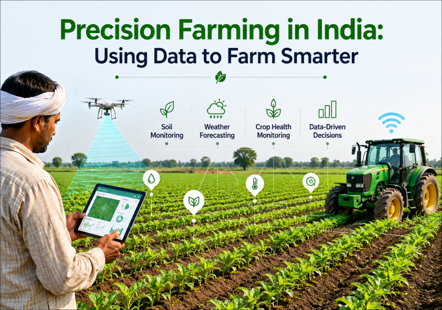
Indian agriculture is changing because of new tools and technologies. Farmers are adopting modern machinery and improved farming methods instead of relying only on seasonal experience. Data now plays an important role in understanding fields, monitoring crops, managing water, and making informed decisions.
This approach is known as precision farming. It combines information from soil, weather, crops, satellites, sensors, and farm equipment to help farmers use resources more efficiently. Rather than treating an entire field in the same way, precision farming identifies differences across the land. Some areas may require more water or nutrients, while others may need less crop protection.
As technology is becoming easier to use in India precision farming can help agriculture be more productive. It can help agriculture be more efficient. It can help agriculture be more sustainable.
What Is Precision Farming?
Precision farming is a way of doing things on farms. It uses data and technology to help farmers make decisions. Farmers can get information about the soil how much water is in the soil how healthy the crops are and what the weather is like.
They can use this information to figure out when to plant seeds how water to give the crops, where to put fertilisers and when the crops need to be protected.
The main idea of precision farming is simple: farmers should use the things in the right amount in the right place and, at the right time.
This way farmers do not waste farm resources. They can make decisions based on what is actually happening in the field with precision farming.
How Data Helps Farmers Make Better Decisions
Data is at the centre of precision farming. Farmers can collect information through soil testing, weather stations, sensors, GPS systems, satellite images and mobile applications.
For example soil data can show differences, in nutrient levels across a field. Of applying the same amount of fertilizer everywhere farmers can identify areas that require additional nutrients.
Weather data can also help farmers plan irrigation and agricultural activities. Knowing about expected rainfall can prevent watering and help farmers prepare for extreme weather conditions.
Over time farmers can also compare data from seasons. This can help them understand which crops perform better where problems frequently occur and how farming practices affect production.
Smart Irrigation Can Save Water
Water management is a part of precision farming. The old way of watering fields can be wasteful. This is because water is spread evenly even if some parts of the field are dry and others are not.
Soil moisture sensors are really helpful. They tell us how much water is in the soil. Farmers can use this information to figure out when they need to water their fields.
There are also automated irrigation systems. These systems give water to the crops when they need it. This way we do not waste water. The crops grow better.
In places where water’s scarce precision farming can make a big difference. Precision farming helps farmers make decisions about water management. Water management is important, for precision farming.
Satellite Images Can Help Monitor Crop Health
Farmers don’t always have to go to every part of a field and look at it. Satellite technology can send pictures that help spot changes in how cropsre doing.
Satellite monitoring can show places that have issues with water or where plants are not growing well or where bugs are causing trouble. Farmers can then check those spots instead of spending a lot of time looking at the whole field.
This is very helpful, for farms where checking everything by hand takes a lot of time and effort.
Sensors and IoT Bring Real-Time Information
The Internet of Things or the Internet of Things is really important for precision agriculture. The Internet of Things devices can get information from fields. Then send this information to digital platforms.
There are sensors that can check the soil moisture the temperature, the humidity and other things. Farmers can see all this information on their phone or their computer it just depends on what system they are using.
When farmers get information in time from the Internet of Things they can do something, about it faster when things change in the field. For example if the soil moisture suddenly gets really low that means the Internet of Things is telling the farmer that they need to water the field.
GPS and Smart Farm Equipment Improve Accuracy
Farmers can use GPS technology to make a map of their fields and keep track of what they do on the farm. This helps them use their machinery in a way remember where the edges of the fields are and use the right amount of seeds and water.
New farm equipment can also keep track of what farmers do when they plant, spray and harvest their crops. This information is very useful for farmers to look at later and see what they can do better.
When we have machinery and digital systems working together we can get more work done without doing the same thing over and over. For example a new tractor, with the technology can help farmers work in the fields more accurately and collect useful information. GPS technology and farm equipment can really help farmers do their job better.
Artificial Intelligence Can Analyse Agricultural Data
Farmers can create a lot of information from sensors, weather services, satellite images and farm documents. Looking at all this information by hand can be hard.
Artificial intelligence can help deal with sets of data and find patterns. AI systems can help with checking crops looking at weather finding pests and predicting how much will be harvested.
For instance computer vision can look at pictures of crops and spot signs of illness or missing nutrients. Finding these problems early can let farmers check the issue before it gets worse over an area.
Ai should be used as a tool to help make decisions. Farmers and people who know about farming still have a job, in understanding what is happening in their area and deciding what to do next..
Challenges in Adopting Precision Farming
Precision farming has a lot of things to offer but it is not always easy to start using it. The price of things like sensors and software and special equipment can be a problem for small farmers who do not have a lot of money.
Farmers also need to know how to use technology and understand the information it gives them. This is a part of precision farming.
Internet connection is another thing that can cause problems in areas that are far away from cities. This is why the people who make solutions for farmers should make sure they are cheap and easy to use and can be used by people who speak different languages. These solutions should also work for farms of all sizes.
Training and helping farmers is just as important as the technology they use. Precision farming is not about the technology it is also, about helping farmers learn how to use it.
What Is the Future of Precision Farming in India?
The future of agriculture is expected to include more use of data and technology. As phones, cheap sensors, satellite services, AI tools and connected machines become easier to get precision farming can help farmers
Government programs companies that make farming tools, groups that help farmers and farmer associations can also help by offering training and low-cost options.
The aim should not be to make farming more difficult. Instead technology should make daily choices simpler. Help farmers use what they have in a better way.
Conclusion
Precision farming is changing the way agricultural decisions are made in India. By using soil information, weather data, satellite imagery, sensors, GPS and artificial intelligence farmers can get an understanding of their fields.
Better information can help with using water efficiently applying inputs in the right places finding problems early and planning the farm better. Even though cost, internet access and digital skills are still problems, more development and teaching farmers can help these technologies become easier to use.
Precision farming is, about making better choices with better information. As digital technology plays a role in farming data-based farming can help Indian farmers work better and move toward a more sustainable way of farming.